
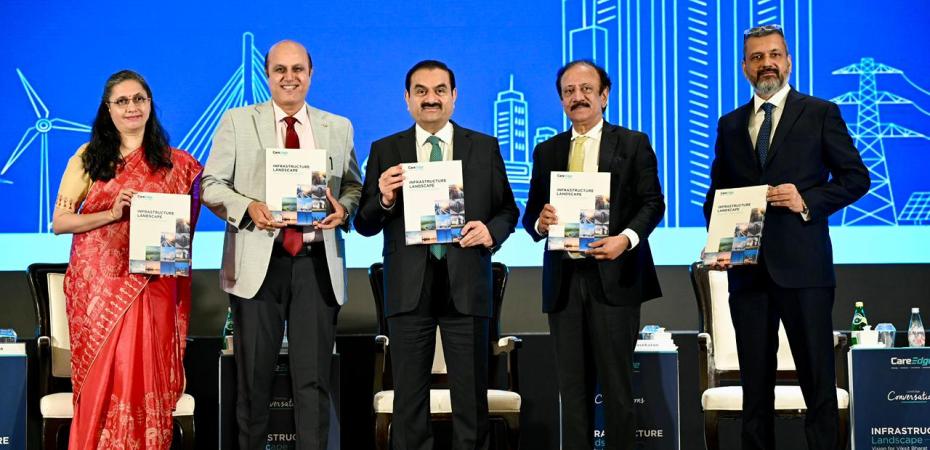
- The Chairman of the Adani Group has urged CareEdge Group to develop what he described as the world’s first comprehensive Credit Framework for Integrated Platform Infrastructure, capable of assessing multi-dimensional infrastructure, the wider economic benefits it creates and the additional value generated around a core asset.
- Mr Adani said transformational infrastructure can create ecosystems, strategic resilience and new sources of demand that may not be captured by assessing an asset’s standalone financial profile, citing the Group’s Mundra port and the 30-gigawatt (GW) renewable energy park at Khavda in Gujarat and Vizhinjam International Seaport in Kerala.
- He stressed that the proposal is not for easier ratings or less scrutiny, but for “wider lenses” and dynamic models that can distinguish between unviable ambition and infrastructure platforms whose economic and strategic value extends beyond conventional measures.
Mr Gautam Adani, Chairman of the Adani Group, has urged CareEdge Group, one of India’s leading credit rating institutions, to develop what he described as the world’s first comprehensive Credit Framework for Integrated Platform Infrastructure, asking why such a framework should not come from India and why it should not lead the effort.
Mr Adani said his association with CareEdge Group spans almost two decades. The relationship now extends to more than ₹3 lakh crore of rated assets across 100-plus entities. Against this backdrop, he posed a central question for rating institutions: how can the frameworks used to measure India’s risks also recognise India’s possibilities?
Many analytical frameworks, he noted, were developed when infrastructure evolved incrementally, demand was more visible and assets could be assessed in isolation, often through single-asset discounted cash-flow models. India’s infrastructure landscape has changed, requiring the frameworks used to assess it to change with it.
He drew a distinction between three types of infrastructure: replacement infrastructure, where established approaches work well; growth infrastructure, where assessments need to capture ecosystem effects and multiplier value; and “platform infrastructure”, where multiple layers combine to create new demand, new ecosystems and new capabilities.
Mundra port in Gujarat is one example. What began as a port developed into an interconnected network spanning rail, logistics, power and industrial activity. “If we build only for the demand we can see today, India will always be late for the opportunities of tomorrow,” Mr Adani said.
At Vizhinjam International Seaport in Kerala, the value extends beyond port capacity. For decades, India had to tranship its container cargo through Singapore, Dubai and Colombo, with consequences for money, time and strategic autonomy. He pointed out that conventional credit models correctly assess execution risk, but strategic infrastructure also requires recognition of the economic value of sovereign resilience.
Khavda presents a third dimension. The 30-gigawatt renewable energy development brings together energy, artificial intelligence, manufacturing and digital infrastructure. Mr Adani said its significance lies in the convergence of these elements, rather than in power-generation capacity alone.
“Rating frameworks often measure individual assets. But we must realise that the real value in today’s age is being created at the intersection, where ‘energy + data + manufacturing’ converge,” he said.
AI brings the same question into sharper focus. While algorithms, models and software will continue to evolve, AI at scale will require land, data centres, cooling, transmission and large volumes of clean, reliable energy. Mr Adani said the competitive advantage may depend not only on who writes the best code, but also on who can build the infrastructure that allows intelligence to scale.
Mr Adani stressed that this does not mean lowering standards or compromising independence. “We do not need lower standards but we need wider lenses,” he said, calling for dynamic models that recognise ecosystem multipliers and strategic resilience.
The proposed CareEdge framework would evaluate multi-dimensional infrastructure, ecosystem multipliers and adjacency value, with the potential to become a benchmark for emerging economies if developed in India.
He said the shift would require seeing both what can be built and whether it can withstand scrutiny.
“A builder imagines what does not yet exist. An analyst questions whether imagination can survive reality. Both perspectives are necessary.”
Mr Adani signed off by calling for the discipline of credit assessment to be preserved while making it capable of capturing value created across integrated infrastructure platforms.

